CAFOs, Data Centers and Local Control
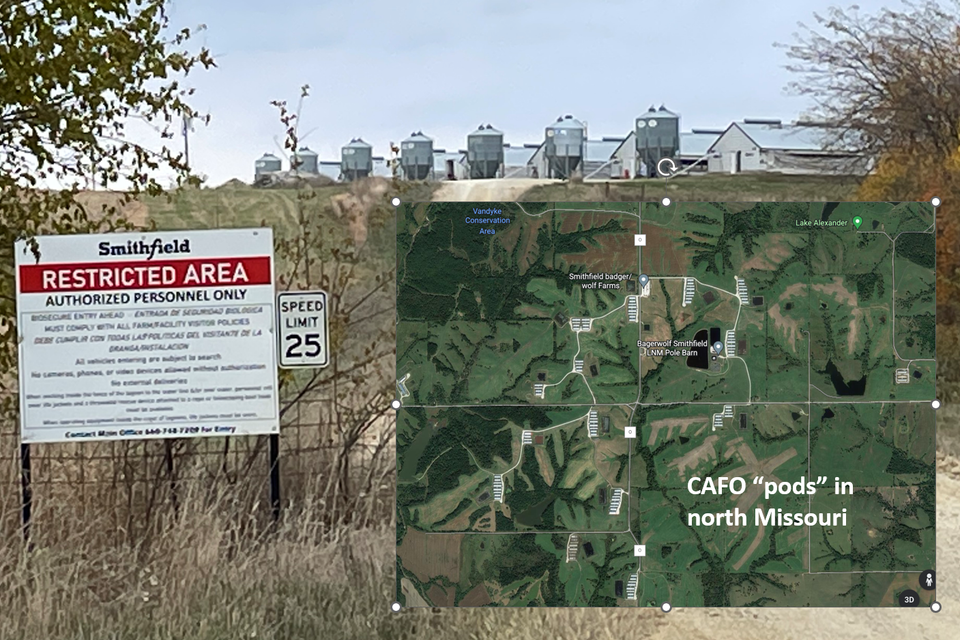
A few decades ago, Premium Standard Farms, a nation-wide pork-producer, decided to make a move on northern Missouri. Like other agribusiness giants, Premium (later Smithfield) had mastered the “vertical integration” model pioneered by Don Tyson in Arkansas, controlling every stage of production from piglet to package. Growing pigs in confinement is very efficient, giving Premium a competitive advantage over family-scale operations. Premium made big profits on CAFOs in Iowa, so why not expand southward? After all, the geographic and political considerations were similar on either side of the imaginary state line.
The company first used its political clout to align Missouri legislators with its expansion plans by getting three counties exempted from the corporate farming law—the law forbidding foreign-owned corporations from buying Missouri farmland. The company also used its legislative influence to convince counties that it was in their best interests to allow CAFOs—more jobs, increased tax base, economic stimulation.
The three counties were eager for an upturn, having just come off the family farm crisis—the foreclosures and buyouts of the 1980s. Not everyone in the counties, of course, wanted the CAFOs. Willie Nelson, who staged Farm-Aid in 1985 to draw attention to the plight of the family farm, headlined an anti-CAFO rally in north Missouri. But the companies successfully countered opposition with careful legal and political maneuvers.
For example, when counties attempted to put local CAFO ordinances in place, agribusiness companies (hereafter called BigAg-BA) challenged their constitutional authority to enact “zoning” restrictions on agriculture. The Missouri Supreme Court sided with BA. BA got “regular” citizens booted off the Clean Water Commission, the state’s water pollution rule-making body, replacing them with people tightly connected to agriculture—clearly a conflict of interest.
BA made sure its high-paid attorneys attended every Clean Water Commission meeting to make sure Commissioners voted the “right” way. And to cap it off, BA’s hand-picked legislators passed Senate Bill 391, which said that no county could have rules more stringent than the state’s, which, thanks for their Commission-stacking efforts, were not stringent to begin with.
And what happened to the northern Missouri counties when the CAFOs moved in? Did they prosper? Some individuals did—for example, the farmers who sold land to the CAFOs and the BA CEOs and stockholders. CAFOs did create jobs. Not too many people found jobs in the CAFOs themselves, which are highly automated, but it takes a small army of service professionals to keep CAFOs in working condition—IT people, service technicians for pumps, plumbing and electrical systems. Some are locals, but many aren’t, often driving long distances, staying at local motels offering weekly or monthly rates. So, a large percentage of the CAFO jobs aren’t even in the same counties with the CAFOs.
In north Missouri, some local businesses did okay—convenience stores, gas stations, Dollar Generals, and motels, for example. Increased local tax revenues went to schools and roads. But after CAFOs moved in, many people moved away, especially those in proximity to the CAFOs. That was okay with BA, which was eager to buy cheap buffer lands around its properties, reducing complaints. In some respects, the CAFO multi-house pods became sacrificial zones.
Other unanticipated problems surfaced. New road revenues didn’t offset damage done by big company trucks. CAFO workers, most of them non-natives, had higher than normal mental and physical health issues and little or no insurance, putting a strain on local medical services. And not just the smell (most hog waste is land-applied), but the noises of CAFOs were problematic—giant fans running 24 hours a day sounded like jets taking off, and the constant squealing of hogs, which don’t like to be confined, was unnerving.
In overview, the CAFO operating strategy can be boiled down to a few broad principles:
Produce meat as efficiently and cheaply as possible to maximize profits. Make sure no local requirements complicate operations or reduce profits. In the BA parlance, companies look to “level the playing field” or have “consistent regulations” between jurisdictions, making things easier for them. They want BA reps on the Clean Water Commission because they don’t want “non experts” making the rules.
You could sum up the situation this way—with CAFOs, most of the profits go overseas, while the locals are left with the odor, noise, polluted runoff and shit. And the end result is a top capitalistic goal—concentrating money and power into the hands of a few people at the top of the corporate pyramid.
Now let’s talk about Data Centers, something I know very little about, at least technically. But similarities between CAFOs and Data Centers (DCs) are in some ways striking. Like CAFOs of a few decades ago, DCs are advancing over the landscape at an alarming rate. For companies siting DCs, it’s a land rush, with wild speculation, looking for cheap land, cheap energy, low citizen resistance and few regulations. This puts rural America in the cross-hairs. Of the roughly 1,500 DCs proposed or under development, two-thirds are in rural areas.
Few people want to live by a DC. In Texas, which now has 250 proposed DCs, 56% of people say they wouldn’t want one near them. There are good reasons for this, even for people who don’t really understand what happens at a DC. Because people fear or dislike them, DCs will almost certainly diminish nearby land values. And there are good reasons to be distrustful. We’ve seen booms and busts before. For most of us, our homes or farms are our biggest investments. Shareholders worry about their company’s investments, but not because their kids will be living there.
As with CAFOs, promoters of DCs want to stifle local control, to make sure no new rules interfere with siting DCs and making profits. They will lean on state legislators to prevent locals from adopting their own rules the way BA did with CAFOs—by using their political clout. And like Premium and Smithfield, DCs will concentrate power into a very few hands, with questionable ancillary benefits to communities. With their newfound power, DC magnates will be able to squeeze out competition, like CAFOs did, and raise rates. As several communities have already found with new DCs, electric rates have not plummeted, and in some cases have risen.
Luckily, there are several differences between the CAFO and DC playing fields. The public is largely opposed to DCs, even before any have arrived in the community. In northern Missouri, people at first welcomed CAFOs, only later re-thinking the wisdom of that. In contrast, there are usually few local proponents of DC projects. And like CAFOs, we’ve learned that some places to build DCs are better than others. With CAFOs, it’s land suitable for application of wastes; access to corn and transportation networks, and large buffer lands.
We have a data center at Springfield Underground that has been there for decades. Because the underground is a constant 60 degrees, cooling is less of a consideration there. Because the DC is underground, noise isn’t a factor for neighbors. To me, this is an example of beneficial use of a mined-out space—a good place for a DC. Every site has other constraints, other conditions that must be considered. That’s why we must retain local control of this emerging technological colossus.
Springfield has put a 120-day administrative hold on new DCs to allow time to gather public input and develop appropriate rules. With the massive amount of public concern and input, much if not most of it negative, that is just not enough time. A one-year pause might not even be enough. In my opinion, there is little to fear in “losing out” by not jumping on the DC bandwagon right now. There are just too many unanswered questions; too many legitimate concerns.
Sure, it’s partly a NIMBY problem, but it goes deeper than that. We just finished a multi-year visioning process that is expected to guide our community’s decision-making for decades. The plan is full of worthy ideas and goals. But DCs were never discussed, to any extent, during that process, even though they could have profound and lasting effects on our community. Just like our citizens asked the city to hold off on a multi-million-dollar convention center, let’s take a deep breath and think more deeply about DCs.
What are the real and lasting benefits to the community? With the technology changing, improving, rapidly getting less water-dependent and more energy-efficient, why rush to get a prototype? What about the concentration of data, and therefore power, into fewer and fewer hands? What constraints or checks and balances against this power may yet be devised by governments, and how will that affect future DC operations? How does the vast increase in carbon-based power that DCs will demand get us any closer to meeting the (way-behind) goals of greenhouse gas reductions? If water is used for cooling, how will that water be cooled and where will it go? If it goes to the sewer, what does that mean for the sewer system and sewage treatment facilities?
A one-year hold may or may not be enough to get answers to these questions. But one thing is certain—three months is definitely not enough.
The company first used its political clout to align Missouri legislators with its expansion plans by getting three counties exempted from the corporate farming law—the law forbidding foreign-owned corporations from buying Missouri farmland. The company also used its legislative influence to convince counties that it was in their best interests to allow CAFOs—more jobs, increased tax base, economic stimulation.
The three counties were eager for an upturn, having just come off the family farm crisis—the foreclosures and buyouts of the 1980s. Not everyone in the counties, of course, wanted the CAFOs. Willie Nelson, who staged Farm-Aid in 1985 to draw attention to the plight of the family farm, headlined an anti-CAFO rally in north Missouri. But the companies successfully countered opposition with careful legal and political maneuvers.
For example, when counties attempted to put local CAFO ordinances in place, agribusiness companies (hereafter called BigAg-BA) challenged their constitutional authority to enact “zoning” restrictions on agriculture. The Missouri Supreme Court sided with BA. BA got “regular” citizens booted off the Clean Water Commission, the state’s water pollution rule-making body, replacing them with people tightly connected to agriculture—clearly a conflict of interest.
BA made sure its high-paid attorneys attended every Clean Water Commission meeting to make sure Commissioners voted the “right” way. And to cap it off, BA’s hand-picked legislators passed Senate Bill 391, which said that no county could have rules more stringent than the state’s, which, thanks for their Commission-stacking efforts, were not stringent to begin with.
And what happened to the northern Missouri counties when the CAFOs moved in? Did they prosper? Some individuals did—for example, the farmers who sold land to the CAFOs and the BA CEOs and stockholders. CAFOs did create jobs. Not too many people found jobs in the CAFOs themselves, which are highly automated, but it takes a small army of service professionals to keep CAFOs in working condition—IT people, service technicians for pumps, plumbing and electrical systems. Some are locals, but many aren’t, often driving long distances, staying at local motels offering weekly or monthly rates. So, a large percentage of the CAFO jobs aren’t even in the same counties with the CAFOs.
In north Missouri, some local businesses did okay—convenience stores, gas stations, Dollar Generals, and motels, for example. Increased local tax revenues went to schools and roads. But after CAFOs moved in, many people moved away, especially those in proximity to the CAFOs. That was okay with BA, which was eager to buy cheap buffer lands around its properties, reducing complaints. In some respects, the CAFO multi-house pods became sacrificial zones.
Other unanticipated problems surfaced. New road revenues didn’t offset damage done by big company trucks. CAFO workers, most of them non-natives, had higher than normal mental and physical health issues and little or no insurance, putting a strain on local medical services. And not just the smell (most hog waste is land-applied), but the noises of CAFOs were problematic—giant fans running 24 hours a day sounded like jets taking off, and the constant squealing of hogs, which don’t like to be confined, was unnerving.
In overview, the CAFO operating strategy can be boiled down to a few broad principles:
Produce meat as efficiently and cheaply as possible to maximize profits. Make sure no local requirements complicate operations or reduce profits. In the BA parlance, companies look to “level the playing field” or have “consistent regulations” between jurisdictions, making things easier for them. They want BA reps on the Clean Water Commission because they don’t want “non experts” making the rules.
You could sum up the situation this way—with CAFOs, most of the profits go overseas, while the locals are left with the odor, noise, polluted runoff and shit. And the end result is a top capitalistic goal—concentrating money and power into the hands of a few people at the top of the corporate pyramid.
Now let’s talk about Data Centers, something I know very little about, at least technically. But similarities between CAFOs and Data Centers (DCs) are in some ways striking. Like CAFOs of a few decades ago, DCs are advancing over the landscape at an alarming rate. For companies siting DCs, it’s a land rush, with wild speculation, looking for cheap land, cheap energy, low citizen resistance and few regulations. This puts rural America in the cross-hairs. Of the roughly 1,500 DCs proposed or under development, two-thirds are in rural areas.
Few people want to live by a DC. In Texas, which now has 250 proposed DCs, 56% of people say they wouldn’t want one near them. There are good reasons for this, even for people who don’t really understand what happens at a DC. Because people fear or dislike them, DCs will almost certainly diminish nearby land values. And there are good reasons to be distrustful. We’ve seen booms and busts before. For most of us, our homes or farms are our biggest investments. Shareholders worry about their company’s investments, but not because their kids will be living there.
As with CAFOs, promoters of DCs want to stifle local control, to make sure no new rules interfere with siting DCs and making profits. They will lean on state legislators to prevent locals from adopting their own rules the way BA did with CAFOs—by using their political clout. And like Premium and Smithfield, DCs will concentrate power into a very few hands, with questionable ancillary benefits to communities. With their newfound power, DC magnates will be able to squeeze out competition, like CAFOs did, and raise rates. As several communities have already found with new DCs, electric rates have not plummeted, and in some cases have risen.
Luckily, there are several differences between the CAFO and DC playing fields. The public is largely opposed to DCs, even before any have arrived in the community. In northern Missouri, people at first welcomed CAFOs, only later re-thinking the wisdom of that. In contrast, there are usually few local proponents of DC projects. And like CAFOs, we’ve learned that some places to build DCs are better than others. With CAFOs, it’s land suitable for application of wastes; access to corn and transportation networks, and large buffer lands.
We have a data center at Springfield Underground that has been there for decades. Because the underground is a constant 60 degrees, cooling is less of a consideration there. Because the DC is underground, noise isn’t a factor for neighbors. To me, this is an example of beneficial use of a mined-out space—a good place for a DC. Every site has other constraints, other conditions that must be considered. That’s why we must retain local control of this emerging technological colossus.
Springfield has put a 120-day administrative hold on new DCs to allow time to gather public input and develop appropriate rules. With the massive amount of public concern and input, much if not most of it negative, that is just not enough time. A one-year pause might not even be enough. In my opinion, there is little to fear in “losing out” by not jumping on the DC bandwagon right now. There are just too many unanswered questions; too many legitimate concerns.
Sure, it’s partly a NIMBY problem, but it goes deeper than that. We just finished a multi-year visioning process that is expected to guide our community’s decision-making for decades. The plan is full of worthy ideas and goals. But DCs were never discussed, to any extent, during that process, even though they could have profound and lasting effects on our community. Just like our citizens asked the city to hold off on a multi-million-dollar convention center, let’s take a deep breath and think more deeply about DCs.
What are the real and lasting benefits to the community? With the technology changing, improving, rapidly getting less water-dependent and more energy-efficient, why rush to get a prototype? What about the concentration of data, and therefore power, into fewer and fewer hands? What constraints or checks and balances against this power may yet be devised by governments, and how will that affect future DC operations? How does the vast increase in carbon-based power that DCs will demand get us any closer to meeting the (way-behind) goals of greenhouse gas reductions? If water is used for cooling, how will that water be cooled and where will it go? If it goes to the sewer, what does that mean for the sewer system and sewage treatment facilities?
A one-year hold may or may not be enough to get answers to these questions. But one thing is certain—three months is definitely not enough.